Monday, we leave for 2 weeks away, then a day at home and the rest of the week gone again (though this time we can take food with us.)
The refrigerator contains a lot of carrots, some swiss chard, a head and a half of lettuce, 2 and half bunches of scallions, a bunch of mizuna, a lot of zucchini and summer squash, some beets with greens I really ought to have cut the tops off of and steamed already, a lot of cucumbers, some adorable cippolini onions, a bunch of basil.
There are also a lot of tomatoes on the counter.
I can leave the carrots, beets, and onions as is in the fridge, I expecct, but the rest of I need to either cook or eat or freeze or give away. All while packing for a trip and being out of the house a bunch. Probably won't have time to blog about what actually happens, till we get back. I hope it isn't "a lot of food for free offered up on our front porch come Monday evening."
Friday, August 3, 2012

Wednesday, June 13, 2012
Brookfield Farm 2012 : The Market Basket Challenge
Another year with our Brookfield Farm CSA, and though this blog mostly took a hiatus for a while, I'm inspired by the new season to start posting, and what better way to encourage that than a weekly project?
This year's challenge: Market Basket.
Market Basket is our town's cheapest supermarket. It is always packed. There is a skill to pushing one's cart through the aisles around pallets of cereal being unloaded (they restock the aisles during store hours), people with their eyes glazed over finding the cheapest jar of peanut butter and figuring out whether their coupon for another brand makes that a better deal, kids wailing that they can't have the bananas from their styrofoam tray RIGHT NOW, and so on. The parking lot has people circling around looking for a parking space. Inside you can often find people loading up their cart with 25 lbs of tripe and chicken feet, and people who obviously work for restaurants buying a cart piled high with 25 lb sacks of rice, because their rice is cheaper than the restaurant supply catalog rice, if I surmise correctly. They sprinkle the floors with sawdust so when stuff inevitably spills it does not make a wet slippery mess.
I love this place! In some ways it is the complete opposite of where one might *think* a picky foodie consumer might shop for their remaining groceries, but to me it makes far more sense than some supposed foodie mecca of expensive, fancy, hippie-packaged goods where you can spend your entire paycheck in one visit. (And when I do get those hippie-packaged goods at Market Basket, I usually win on price by a fair margin, too!) And while it is a "big box" supermarket, the grocery business outside of a few national chains is mostly at a more regional level - and of all the regional chains in our area, apparently Market Basket is the smallest.
Anyway, it always seems to me like my groceries at Market Basket cost half as much as they would at another store, or maybe 75% at most. Rarely is something I buy the same price at Market Basket as at other chains. The produce is generally fresh and high quality, and with the diverse population of Somerville we've got quite an assortment - fresh turmeric root, Thai chilies, fiddleheads... But I don't buy that much of my produce there, only things that are organic (where the variety is not that huge, but they've got me covered for bananas, apples when it's not fall/winter in New England, and broccoli), citrus, on the lower-in-pesticides list, or foraged like the fiddleheads.
But I'm curious how the CSA stacks up against Market Basket. I will a little bit of benefit of the "yuppie" food to the CSA - if Market Basket has an item in both organic-and non-organic I will price it as the organic version.
1 bag washed spinach (Olivia's organics baby spinach, $2.50/box about the same size, on sale)
1 head romaine lettuce (organic, $2.99 for several hearts, but about the same weight)
1 head red leaf lettuce (organic, $2.49)
1 small bunch arugula (organic, $2.50/box, only available in larger box, so call this $1.25 worth)
1 bag mixed braising greens (spring mix, Olivia's organics, $2.50/box about the same size, on sale)
1 large bunch komatsuna (I've never seen komatsuna at Market Basket. Call it $2.50/bunch, too, like the other organic greens including kale and collards.)
1 bunch radishes (non organic, $0.69, on sale)
So, that totals $17.42.
Our share this year is $540 for 24 delivery weeks, so the weekly cost is $22.50. So far, Market Basket is ahead -- but so was the farmer's market, back in 2010.
This year's challenge: Market Basket.
Market Basket is our town's cheapest supermarket. It is always packed. There is a skill to pushing one's cart through the aisles around pallets of cereal being unloaded (they restock the aisles during store hours), people with their eyes glazed over finding the cheapest jar of peanut butter and figuring out whether their coupon for another brand makes that a better deal, kids wailing that they can't have the bananas from their styrofoam tray RIGHT NOW, and so on. The parking lot has people circling around looking for a parking space. Inside you can often find people loading up their cart with 25 lbs of tripe and chicken feet, and people who obviously work for restaurants buying a cart piled high with 25 lb sacks of rice, because their rice is cheaper than the restaurant supply catalog rice, if I surmise correctly. They sprinkle the floors with sawdust so when stuff inevitably spills it does not make a wet slippery mess.
I love this place! In some ways it is the complete opposite of where one might *think* a picky foodie consumer might shop for their remaining groceries, but to me it makes far more sense than some supposed foodie mecca of expensive, fancy, hippie-packaged goods where you can spend your entire paycheck in one visit. (And when I do get those hippie-packaged goods at Market Basket, I usually win on price by a fair margin, too!) And while it is a "big box" supermarket, the grocery business outside of a few national chains is mostly at a more regional level - and of all the regional chains in our area, apparently Market Basket is the smallest.
Anyway, it always seems to me like my groceries at Market Basket cost half as much as they would at another store, or maybe 75% at most. Rarely is something I buy the same price at Market Basket as at other chains. The produce is generally fresh and high quality, and with the diverse population of Somerville we've got quite an assortment - fresh turmeric root, Thai chilies, fiddleheads... But I don't buy that much of my produce there, only things that are organic (where the variety is not that huge, but they've got me covered for bananas, apples when it's not fall/winter in New England, and broccoli), citrus, on the lower-in-pesticides list, or foraged like the fiddleheads.
But I'm curious how the CSA stacks up against Market Basket. I will a little bit of benefit of the "yuppie" food to the CSA - if Market Basket has an item in both organic-and non-organic I will price it as the organic version.
1 bag washed spinach (Olivia's organics baby spinach, $2.50/box about the same size, on sale)
1 head romaine lettuce (organic, $2.99 for several hearts, but about the same weight)
1 head red leaf lettuce (organic, $2.49)
1 small bunch arugula (organic, $2.50/box, only available in larger box, so call this $1.25 worth)
1 bag mixed braising greens (spring mix, Olivia's organics, $2.50/box about the same size, on sale)
1 large bunch komatsuna (I've never seen komatsuna at Market Basket. Call it $2.50/bunch, too, like the other organic greens including kale and collards.)
1 bunch radishes (non organic, $0.69, on sale)
So, that totals $17.42.
Our share this year is $540 for 24 delivery weeks, so the weekly cost is $22.50. So far, Market Basket is ahead -- but so was the farmer's market, back in 2010.
Monday, May 16, 2011
sausages for breakfast
I wound up with a copy of Michael Ruhlman's Charcuterie mainly because I wanted to figure out a way to make a better poultry breakfast sausage. This month, with breakfast-sausage sized casings ordered from the internet, I finally made a first attempt at that goal, egged on by Charcuteapalooza's May challenge.
The challenge was for loose breakfast sausage this month, but in the spirit of learning something new, since I've already had plenty of practice in grinding sausage, my sausage was destined for breakfast sausage sized collagen casings. And we experimented with turkey and chicken sausages (both with just the natural poultry fat). The goal was something tasty, healthy, and even able to be eaten by people who don't eat pork. The bonus would be if I could pre-cook the links and freeze them, for later quick breakfast needs.
In the end, most of that sausage did wind up being loose. We did a small batch of chicken (with purchased boneless chicken thighs) and a small batch of turkey (with turkey drumsticks that required butchering off the bone... a project in itself.) Then, we got to the stuffing phase, and at least so far, I didn't figure out how I could actually make links that stay put in collagen casings, oops. Possibly soaking it first was my problem, and all the other sausage hobbyist posts I found on the internet complaining of the same thing made the same mistake as me. Or possibly collagen sausage just won't form links by twisting. I have more casings in the fridge to experiment with next time, and the rest of the meat went to some straightforward breakfast patties. For breakfast, with pancakes.
In the meantime, since I couldn't make links, the only thing I could think of to do with my coiled length of stuffed sausage was to poach it (as Ruhlman describes for doing with emulsified sausages, though these aren't emulsified) and then once the sausage was cooked and wasn't going to escape the casings, cut it into cylindrical links. Not stylish, but functional. They're in the freezer, waiting to be tested out this week to see if they are good enough to do again.
Boring but functional may be the biggest problem. Homemade sausage is definitely still a project, even after making it enough times over the past few years. Practice does not make you faster at cleaning raw meat off of bowls, trays, and Kitchenaid parts, or at slowly feeding meat through the grinder or at sausage filling through the stuffer. It might help with making links out of collagen casing, if that turns out to be a learnable skill. It might make me faster at butchering turkey drumsticks, but I don't know if I'm going to be practicing that one quite often enough either - the turkey tasted better, but not quite better enough to be worth all that extra trouble. So is all of that worth it for a sausage that I precook and stick straight into the freezer, (and one that's good enough but missing all that tasty tasty extra fat, too) rather than one that I make very special and eat very fresh for a special occasion meal?
But at least in theory, I've finally done what I set out to do when I bought Charcuterie, and will have a breakfast this week one morning that I made myself, that is healthy protein that tastes good and can go straight from freezer to microwave when I'm in a hurry.
The challenge was for loose breakfast sausage this month, but in the spirit of learning something new, since I've already had plenty of practice in grinding sausage, my sausage was destined for breakfast sausage sized collagen casings. And we experimented with turkey and chicken sausages (both with just the natural poultry fat). The goal was something tasty, healthy, and even able to be eaten by people who don't eat pork. The bonus would be if I could pre-cook the links and freeze them, for later quick breakfast needs.
In the end, most of that sausage did wind up being loose. We did a small batch of chicken (with purchased boneless chicken thighs) and a small batch of turkey (with turkey drumsticks that required butchering off the bone... a project in itself.) Then, we got to the stuffing phase, and at least so far, I didn't figure out how I could actually make links that stay put in collagen casings, oops. Possibly soaking it first was my problem, and all the other sausage hobbyist posts I found on the internet complaining of the same thing made the same mistake as me. Or possibly collagen sausage just won't form links by twisting. I have more casings in the fridge to experiment with next time, and the rest of the meat went to some straightforward breakfast patties. For breakfast, with pancakes.
 |
| From chow |
In the meantime, since I couldn't make links, the only thing I could think of to do with my coiled length of stuffed sausage was to poach it (as Ruhlman describes for doing with emulsified sausages, though these aren't emulsified) and then once the sausage was cooked and wasn't going to escape the casings, cut it into cylindrical links. Not stylish, but functional. They're in the freezer, waiting to be tested out this week to see if they are good enough to do again.
Boring but functional may be the biggest problem. Homemade sausage is definitely still a project, even after making it enough times over the past few years. Practice does not make you faster at cleaning raw meat off of bowls, trays, and Kitchenaid parts, or at slowly feeding meat through the grinder or at sausage filling through the stuffer. It might help with making links out of collagen casing, if that turns out to be a learnable skill. It might make me faster at butchering turkey drumsticks, but I don't know if I'm going to be practicing that one quite often enough either - the turkey tasted better, but not quite better enough to be worth all that extra trouble. So is all of that worth it for a sausage that I precook and stick straight into the freezer, (and one that's good enough but missing all that tasty tasty extra fat, too) rather than one that I make very special and eat very fresh for a special occasion meal?
But at least in theory, I've finally done what I set out to do when I bought Charcuterie, and will have a breakfast this week one morning that I made myself, that is healthy protein that tastes good and can go straight from freezer to microwave when I'm in a hurry.
Tuesday, April 19, 2011
Becoming a smoker
The first Charcutepalooza challenge involving smoking meat was this month. (You might notice that I am posting on the 20th instead of the 15th, this month I did smoke the neat on the 15th, but we didn't try it till breakfast on the 16th.)
I made Canadian bacon, brined and hot-smoked pork loin. I remembered it being bit like ham only smoked, and that's about right.

The smoking technique still needs practice. I have grand plans to apply technology and my electric smoker to the task eventually - I have a temperature controller, a data acquisition system to eventually replace the temperature controller with brains that do smoother control, and an electric smoker ready to be controlled -- ready, except that I set up the temperature controller to run a rice cooker, and the smoker requires an outlet with a ground, and I haven't been motivated to modify the temperature controller again. But this is supposed to be a food blog, not a geek blog.
So we made smoke the low-tech way. Ok, not that low tech. I lit the fire with matches, crumpled newspaper, and a chimney, not by rubbing two sticks together. But I did have two sticks, and those went into the project too - the source of smoke for our canadian bacon was the remains from pruning one of our backyard plum trees.
I improvised my smoke and heat source by putting some lit coals in with small bits of the sticks, cut up with the pruning shears, and some shavings from the wood to make sawdust, too. I don't think it worked as well as intended - the heat was slow to get to where I wanted it (indirect heat around 200F) and then the coals burned out too fast. But in the meanwhile, we got some smoke flavor into the meat. Not long enough to fully hot-smoke it to a fully cooked temperature, so then it went into a low oven for a while. The house smelled of tasty smoke by the time that was done, so I knew the smoking part of the adventure had not been for naught.
All those words (and all that work) for a few slices of meat, more brought to a birthday party, and more in the fridge for later. But my, those slices of meat were good.
I made Canadian bacon, brined and hot-smoked pork loin. I remembered it being bit like ham only smoked, and that's about right.

The smoking technique still needs practice. I have grand plans to apply technology and my electric smoker to the task eventually - I have a temperature controller, a data acquisition system to eventually replace the temperature controller with brains that do smoother control, and an electric smoker ready to be controlled -- ready, except that I set up the temperature controller to run a rice cooker, and the smoker requires an outlet with a ground, and I haven't been motivated to modify the temperature controller again. But this is supposed to be a food blog, not a geek blog.
So we made smoke the low-tech way. Ok, not that low tech. I lit the fire with matches, crumpled newspaper, and a chimney, not by rubbing two sticks together. But I did have two sticks, and those went into the project too - the source of smoke for our canadian bacon was the remains from pruning one of our backyard plum trees.
I improvised my smoke and heat source by putting some lit coals in with small bits of the sticks, cut up with the pruning shears, and some shavings from the wood to make sawdust, too. I don't think it worked as well as intended - the heat was slow to get to where I wanted it (indirect heat around 200F) and then the coals burned out too fast. But in the meanwhile, we got some smoke flavor into the meat. Not long enough to fully hot-smoke it to a fully cooked temperature, so then it went into a low oven for a while. The house smelled of tasty smoke by the time that was done, so I knew the smoking part of the adventure had not been for naught.
All those words (and all that work) for a few slices of meat, more brought to a birthday party, and more in the fridge for later. But my, those slices of meat were good.
Tuesday, March 15, 2011
a few days early for St. Patrick's Day
This month's charcutepalooza challenge was brining - corned beef tongue, or corned beef brisket, or if one was feeling less ambitious, brined pork chops.
I've brined tongue tongue several times already - our meat CSA often has it in the bargain bin at pickup, and having home-cured corned beef tongue for under a dollar a pound is hard to pass up.
So in the spirit of having charcutepalooza be about trying something new, I brined a small brisket from the meat CSA instead. Really pushing boundaries, for me - brisket was once this very inexpensive cut of meat, but nowadays it's not, especially when sourced from a small local farm! And corned beef is tasty but to me it still belongs those "good cheap eats" category. Whereas I love Jewish holiday brisket. So, would CSA meat turn it into something amazing, something that makes it more worth doing than my old standby?

Alas, the answer for me was "no". Fun to eat corned beef I made myself, nice and pretty, but mostly tasted just like the industrially corned ones at the supermarket, to me. I vote for just corning tongue next time and I'll save the next brisket for Passover. However, my mother-in-law, visiting from Croatia where the supermarkets do not abound with corned beef every March, is thinking about bringing some pink salt home with her...
On another note, I did also brine some porkchops, this month's apprentice challenge. That was a bit more of a revelation, to be honest - 2 hours in a simply spiced brine makes for a totally transformed piece of pork - different texture, different flavor - not quite a pork chop, not quite a ham either.
I've brined tongue tongue several times already - our meat CSA often has it in the bargain bin at pickup, and having home-cured corned beef tongue for under a dollar a pound is hard to pass up.
So in the spirit of having charcutepalooza be about trying something new, I brined a small brisket from the meat CSA instead. Really pushing boundaries, for me - brisket was once this very inexpensive cut of meat, but nowadays it's not, especially when sourced from a small local farm! And corned beef is tasty but to me it still belongs those "good cheap eats" category. Whereas I love Jewish holiday brisket. So, would CSA meat turn it into something amazing, something that makes it more worth doing than my old standby?

Alas, the answer for me was "no". Fun to eat corned beef I made myself, nice and pretty, but mostly tasted just like the industrially corned ones at the supermarket, to me. I vote for just corning tongue next time and I'll save the next brisket for Passover. However, my mother-in-law, visiting from Croatia where the supermarkets do not abound with corned beef every March, is thinking about bringing some pink salt home with her...
On another note, I did also brine some porkchops, this month's apprentice challenge. That was a bit more of a revelation, to be honest - 2 hours in a simply spiced brine makes for a totally transformed piece of pork - different texture, different flavor - not quite a pork chop, not quite a ham either.
Tuesday, February 15, 2011
Pancetta Starts with P
This month's Charcutepalooza challenge was curing bacon or pancetta. I split the difference and chose the pancetta recipe but without the rolling. The fresh bacon / belly I had in my freezer was a pretty small amount - the wrong shape to roll it up into a pretty spiral. It'll taste the same anyway. And it wound up fairly pretty and round:

Apparently I should have removed the skin before curing - at least if I was going to roll it up into a cylinder which now has a curved, hard, skin on the end. Oh well. Lesson learned for next time. And there will be a next time. YUM.
I was saving my last few parsnips from the winter farmshare this season for one of my favorite dishes starring parsnips. Conveniently, it also needs pancetta. I first found a version of this recipe from Martha Stewart. (I know, I know.. but it's tasty, and simple.) Martha obviously doesn't serve this to kids in pre-k, or have the same sense of humor as I do, though, so she ignores the great alliteration potential - Pasta with Parsnips, Parmesan, Pancetta, Pepper, and Parsley. I made both the 5 year old and the other grownup laugh by pairing it with Pink grapefruit juice. "Mommy, why did you make grapefruit juice? That doesn't start with P." "Ah. But what color grapefruit did it come from?"


Apparently I should have removed the skin before curing - at least if I was going to roll it up into a cylinder which now has a curved, hard, skin on the end. Oh well. Lesson learned for next time. And there will be a next time. YUM.
I was saving my last few parsnips from the winter farmshare this season for one of my favorite dishes starring parsnips. Conveniently, it also needs pancetta. I first found a version of this recipe from Martha Stewart. (I know, I know.. but it's tasty, and simple.) Martha obviously doesn't serve this to kids in pre-k, or have the same sense of humor as I do, though, so she ignores the great alliteration potential - Pasta with Parsnips, Parmesan, Pancetta, Pepper, and Parsley. I made both the 5 year old and the other grownup laugh by pairing it with Pink grapefruit juice. "Mommy, why did you make grapefruit juice? That doesn't start with P." "Ah. But what color grapefruit did it come from?"

Thursday, February 10, 2011
Duck Prosciuitto Chicken? Duck Prosciutto Bacon.
The first project in Charcutepalooza, the one I read about just as it was happening, was duck prosciutto. Take a duck breast, cover it in salt for a day, then hang it to dry for a week, and you're done. So I headed to Sherman Market, picked up a duck breast from New York State, and gave it a try.
I wasn't particularly afraid to start making the duck prosciutto. After all, I've tried salting cod before, and this wasn't so different, plus the weather cooperated. I didn't even check that I knew where our cheesecloth was before I stuck the duck breast into the salt in the fridge overnight. (And then I didn't. Know where it was, that is. Did you know that a "turkey stuffing kit" from the supermarket contains a cheesecloth bag, twine, and bits of metal that make adequate hooks to hang up a piece of meat to dry?)
What it turned out I was somewhat afraid of was eating the duck prosciutto. You see, it's supposed to turn firmer after a day dehydrating in the salt, and then firm up as it turns into a cured meat product hanging in a cool space for a week. And it seemed different - but I've never eaten duck prosciutto, nor have I eaten anything I've cured that wasn't also meant to be cooked before eating.
Then I decided that it looked a bit like bacon, with the nice red color, the gorgeous strip of fat on one side..the not-so-thin slices I was able to make... So our first taste of the duck prosciutto was fried up bacon-style, to go along with a little french toast. Tasty, and cured-tasting like bacon. Not too crispy because I like my bacon to taste meaty anyway. But still, not the most exciting texture, and not worth buying a duck breast and then watching it cure for a week, either.
So. I had to convince myself it was really cured. A little more poking, a little more prodding, a small nibble from my husband and I , and we proclaimed it safe to eat. (Also, tasty. Pretty intense flavor, and very smooth and silky.)
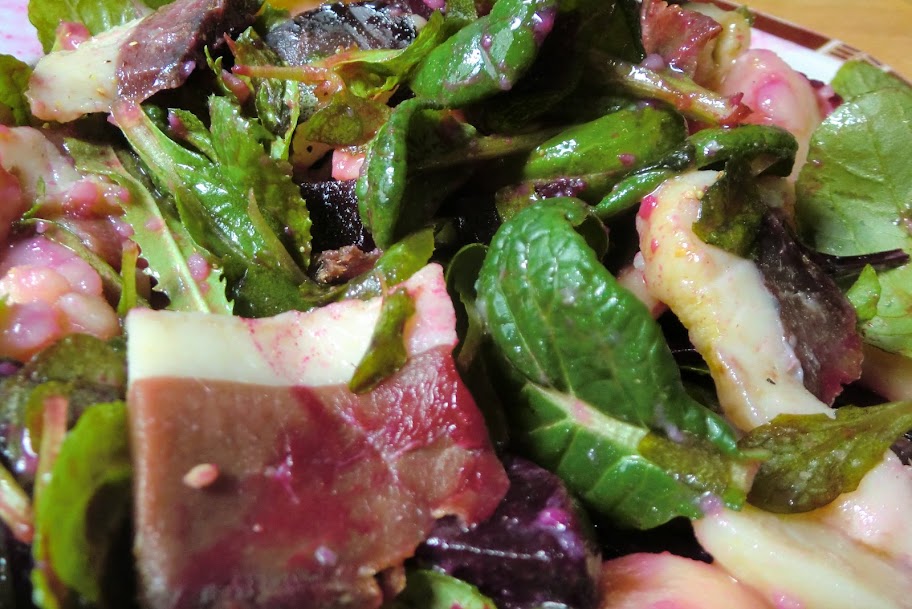
For lunch I ate this salad, with some generous slices of duck prosciutto without further cooking, beets, potatoes, and tiny greens grown in a greenhouse in Westport MA, and a little vinaigrette.
I'm still here.
Subscribe to:
Posts (Atom)