
Monday, we leave for 2 weeks away, then a day at home and the rest of the week gone again (though this time we can take food with us.)
The refrigerator contains a lot of carrots, some swiss chard, a head and a half of lettuce, 2 and half bunches of scallions, a bunch of mizuna, a lot of zucchini and summer squash, some beets with greens I really ought to have cut the tops off of and steamed already, a lot of cucumbers, some adorable cippolini onions, a bunch of basil.
There are also a lot of tomatoes on the counter.
I can leave the carrots, beets, and onions as is in the fridge, I expecct, but the rest of I need to either cook or eat or freeze or give away. All while packing for a trip and being out of the house a bunch. Probably won't have time to blog about what actually happens, till we get back. I hope it isn't "a lot of food for free offered up on our front porch come Monday evening."
Friday, August 3, 2012

Wednesday, June 13, 2012
Brookfield Farm 2012 : The Market Basket Challenge
Another year with our Brookfield Farm CSA, and though this blog mostly took a hiatus for a while, I'm inspired by the new season to start posting, and what better way to encourage that than a weekly project?
This year's challenge: Market Basket.
Market Basket is our town's cheapest supermarket. It is always packed. There is a skill to pushing one's cart through the aisles around pallets of cereal being unloaded (they restock the aisles during store hours), people with their eyes glazed over finding the cheapest jar of peanut butter and figuring out whether their coupon for another brand makes that a better deal, kids wailing that they can't have the bananas from their styrofoam tray RIGHT NOW, and so on. The parking lot has people circling around looking for a parking space. Inside you can often find people loading up their cart with 25 lbs of tripe and chicken feet, and people who obviously work for restaurants buying a cart piled high with 25 lb sacks of rice, because their rice is cheaper than the restaurant supply catalog rice, if I surmise correctly. They sprinkle the floors with sawdust so when stuff inevitably spills it does not make a wet slippery mess.
I love this place! In some ways it is the complete opposite of where one might *think* a picky foodie consumer might shop for their remaining groceries, but to me it makes far more sense than some supposed foodie mecca of expensive, fancy, hippie-packaged goods where you can spend your entire paycheck in one visit. (And when I do get those hippie-packaged goods at Market Basket, I usually win on price by a fair margin, too!) And while it is a "big box" supermarket, the grocery business outside of a few national chains is mostly at a more regional level - and of all the regional chains in our area, apparently Market Basket is the smallest.
Anyway, it always seems to me like my groceries at Market Basket cost half as much as they would at another store, or maybe 75% at most. Rarely is something I buy the same price at Market Basket as at other chains. The produce is generally fresh and high quality, and with the diverse population of Somerville we've got quite an assortment - fresh turmeric root, Thai chilies, fiddleheads... But I don't buy that much of my produce there, only things that are organic (where the variety is not that huge, but they've got me covered for bananas, apples when it's not fall/winter in New England, and broccoli), citrus, on the lower-in-pesticides list, or foraged like the fiddleheads.
But I'm curious how the CSA stacks up against Market Basket. I will a little bit of benefit of the "yuppie" food to the CSA - if Market Basket has an item in both organic-and non-organic I will price it as the organic version.
1 bag washed spinach (Olivia's organics baby spinach, $2.50/box about the same size, on sale)
1 head romaine lettuce (organic, $2.99 for several hearts, but about the same weight)
1 head red leaf lettuce (organic, $2.49)
1 small bunch arugula (organic, $2.50/box, only available in larger box, so call this $1.25 worth)
1 bag mixed braising greens (spring mix, Olivia's organics, $2.50/box about the same size, on sale)
1 large bunch komatsuna (I've never seen komatsuna at Market Basket. Call it $2.50/bunch, too, like the other organic greens including kale and collards.)
1 bunch radishes (non organic, $0.69, on sale)
So, that totals $17.42.
Our share this year is $540 for 24 delivery weeks, so the weekly cost is $22.50. So far, Market Basket is ahead -- but so was the farmer's market, back in 2010.
This year's challenge: Market Basket.
Market Basket is our town's cheapest supermarket. It is always packed. There is a skill to pushing one's cart through the aisles around pallets of cereal being unloaded (they restock the aisles during store hours), people with their eyes glazed over finding the cheapest jar of peanut butter and figuring out whether their coupon for another brand makes that a better deal, kids wailing that they can't have the bananas from their styrofoam tray RIGHT NOW, and so on. The parking lot has people circling around looking for a parking space. Inside you can often find people loading up their cart with 25 lbs of tripe and chicken feet, and people who obviously work for restaurants buying a cart piled high with 25 lb sacks of rice, because their rice is cheaper than the restaurant supply catalog rice, if I surmise correctly. They sprinkle the floors with sawdust so when stuff inevitably spills it does not make a wet slippery mess.
I love this place! In some ways it is the complete opposite of where one might *think* a picky foodie consumer might shop for their remaining groceries, but to me it makes far more sense than some supposed foodie mecca of expensive, fancy, hippie-packaged goods where you can spend your entire paycheck in one visit. (And when I do get those hippie-packaged goods at Market Basket, I usually win on price by a fair margin, too!) And while it is a "big box" supermarket, the grocery business outside of a few national chains is mostly at a more regional level - and of all the regional chains in our area, apparently Market Basket is the smallest.
Anyway, it always seems to me like my groceries at Market Basket cost half as much as they would at another store, or maybe 75% at most. Rarely is something I buy the same price at Market Basket as at other chains. The produce is generally fresh and high quality, and with the diverse population of Somerville we've got quite an assortment - fresh turmeric root, Thai chilies, fiddleheads... But I don't buy that much of my produce there, only things that are organic (where the variety is not that huge, but they've got me covered for bananas, apples when it's not fall/winter in New England, and broccoli), citrus, on the lower-in-pesticides list, or foraged like the fiddleheads.
But I'm curious how the CSA stacks up against Market Basket. I will a little bit of benefit of the "yuppie" food to the CSA - if Market Basket has an item in both organic-and non-organic I will price it as the organic version.
1 bag washed spinach (Olivia's organics baby spinach, $2.50/box about the same size, on sale)
1 head romaine lettuce (organic, $2.99 for several hearts, but about the same weight)
1 head red leaf lettuce (organic, $2.49)
1 small bunch arugula (organic, $2.50/box, only available in larger box, so call this $1.25 worth)
1 bag mixed braising greens (spring mix, Olivia's organics, $2.50/box about the same size, on sale)
1 large bunch komatsuna (I've never seen komatsuna at Market Basket. Call it $2.50/bunch, too, like the other organic greens including kale and collards.)
1 bunch radishes (non organic, $0.69, on sale)
So, that totals $17.42.
Our share this year is $540 for 24 delivery weeks, so the weekly cost is $22.50. So far, Market Basket is ahead -- but so was the farmer's market, back in 2010.
Monday, May 16, 2011
sausages for breakfast
I wound up with a copy of Michael Ruhlman's Charcuterie mainly because I wanted to figure out a way to make a better poultry breakfast sausage. This month, with breakfast-sausage sized casings ordered from the internet, I finally made a first attempt at that goal, egged on by Charcuteapalooza's May challenge.
The challenge was for loose breakfast sausage this month, but in the spirit of learning something new, since I've already had plenty of practice in grinding sausage, my sausage was destined for breakfast sausage sized collagen casings. And we experimented with turkey and chicken sausages (both with just the natural poultry fat). The goal was something tasty, healthy, and even able to be eaten by people who don't eat pork. The bonus would be if I could pre-cook the links and freeze them, for later quick breakfast needs.
In the end, most of that sausage did wind up being loose. We did a small batch of chicken (with purchased boneless chicken thighs) and a small batch of turkey (with turkey drumsticks that required butchering off the bone... a project in itself.) Then, we got to the stuffing phase, and at least so far, I didn't figure out how I could actually make links that stay put in collagen casings, oops. Possibly soaking it first was my problem, and all the other sausage hobbyist posts I found on the internet complaining of the same thing made the same mistake as me. Or possibly collagen sausage just won't form links by twisting. I have more casings in the fridge to experiment with next time, and the rest of the meat went to some straightforward breakfast patties. For breakfast, with pancakes.
In the meantime, since I couldn't make links, the only thing I could think of to do with my coiled length of stuffed sausage was to poach it (as Ruhlman describes for doing with emulsified sausages, though these aren't emulsified) and then once the sausage was cooked and wasn't going to escape the casings, cut it into cylindrical links. Not stylish, but functional. They're in the freezer, waiting to be tested out this week to see if they are good enough to do again.
Boring but functional may be the biggest problem. Homemade sausage is definitely still a project, even after making it enough times over the past few years. Practice does not make you faster at cleaning raw meat off of bowls, trays, and Kitchenaid parts, or at slowly feeding meat through the grinder or at sausage filling through the stuffer. It might help with making links out of collagen casing, if that turns out to be a learnable skill. It might make me faster at butchering turkey drumsticks, but I don't know if I'm going to be practicing that one quite often enough either - the turkey tasted better, but not quite better enough to be worth all that extra trouble. So is all of that worth it for a sausage that I precook and stick straight into the freezer, (and one that's good enough but missing all that tasty tasty extra fat, too) rather than one that I make very special and eat very fresh for a special occasion meal?
But at least in theory, I've finally done what I set out to do when I bought Charcuterie, and will have a breakfast this week one morning that I made myself, that is healthy protein that tastes good and can go straight from freezer to microwave when I'm in a hurry.
The challenge was for loose breakfast sausage this month, but in the spirit of learning something new, since I've already had plenty of practice in grinding sausage, my sausage was destined for breakfast sausage sized collagen casings. And we experimented with turkey and chicken sausages (both with just the natural poultry fat). The goal was something tasty, healthy, and even able to be eaten by people who don't eat pork. The bonus would be if I could pre-cook the links and freeze them, for later quick breakfast needs.
In the end, most of that sausage did wind up being loose. We did a small batch of chicken (with purchased boneless chicken thighs) and a small batch of turkey (with turkey drumsticks that required butchering off the bone... a project in itself.) Then, we got to the stuffing phase, and at least so far, I didn't figure out how I could actually make links that stay put in collagen casings, oops. Possibly soaking it first was my problem, and all the other sausage hobbyist posts I found on the internet complaining of the same thing made the same mistake as me. Or possibly collagen sausage just won't form links by twisting. I have more casings in the fridge to experiment with next time, and the rest of the meat went to some straightforward breakfast patties. For breakfast, with pancakes.
 |
| From chow |
In the meantime, since I couldn't make links, the only thing I could think of to do with my coiled length of stuffed sausage was to poach it (as Ruhlman describes for doing with emulsified sausages, though these aren't emulsified) and then once the sausage was cooked and wasn't going to escape the casings, cut it into cylindrical links. Not stylish, but functional. They're in the freezer, waiting to be tested out this week to see if they are good enough to do again.
Boring but functional may be the biggest problem. Homemade sausage is definitely still a project, even after making it enough times over the past few years. Practice does not make you faster at cleaning raw meat off of bowls, trays, and Kitchenaid parts, or at slowly feeding meat through the grinder or at sausage filling through the stuffer. It might help with making links out of collagen casing, if that turns out to be a learnable skill. It might make me faster at butchering turkey drumsticks, but I don't know if I'm going to be practicing that one quite often enough either - the turkey tasted better, but not quite better enough to be worth all that extra trouble. So is all of that worth it for a sausage that I precook and stick straight into the freezer, (and one that's good enough but missing all that tasty tasty extra fat, too) rather than one that I make very special and eat very fresh for a special occasion meal?
But at least in theory, I've finally done what I set out to do when I bought Charcuterie, and will have a breakfast this week one morning that I made myself, that is healthy protein that tastes good and can go straight from freezer to microwave when I'm in a hurry.
Tuesday, April 19, 2011
Becoming a smoker
The first Charcutepalooza challenge involving smoking meat was this month. (You might notice that I am posting on the 20th instead of the 15th, this month I did smoke the neat on the 15th, but we didn't try it till breakfast on the 16th.)
I made Canadian bacon, brined and hot-smoked pork loin. I remembered it being bit like ham only smoked, and that's about right.

The smoking technique still needs practice. I have grand plans to apply technology and my electric smoker to the task eventually - I have a temperature controller, a data acquisition system to eventually replace the temperature controller with brains that do smoother control, and an electric smoker ready to be controlled -- ready, except that I set up the temperature controller to run a rice cooker, and the smoker requires an outlet with a ground, and I haven't been motivated to modify the temperature controller again. But this is supposed to be a food blog, not a geek blog.
So we made smoke the low-tech way. Ok, not that low tech. I lit the fire with matches, crumpled newspaper, and a chimney, not by rubbing two sticks together. But I did have two sticks, and those went into the project too - the source of smoke for our canadian bacon was the remains from pruning one of our backyard plum trees.
I improvised my smoke and heat source by putting some lit coals in with small bits of the sticks, cut up with the pruning shears, and some shavings from the wood to make sawdust, too. I don't think it worked as well as intended - the heat was slow to get to where I wanted it (indirect heat around 200F) and then the coals burned out too fast. But in the meanwhile, we got some smoke flavor into the meat. Not long enough to fully hot-smoke it to a fully cooked temperature, so then it went into a low oven for a while. The house smelled of tasty smoke by the time that was done, so I knew the smoking part of the adventure had not been for naught.
All those words (and all that work) for a few slices of meat, more brought to a birthday party, and more in the fridge for later. But my, those slices of meat were good.
I made Canadian bacon, brined and hot-smoked pork loin. I remembered it being bit like ham only smoked, and that's about right.

The smoking technique still needs practice. I have grand plans to apply technology and my electric smoker to the task eventually - I have a temperature controller, a data acquisition system to eventually replace the temperature controller with brains that do smoother control, and an electric smoker ready to be controlled -- ready, except that I set up the temperature controller to run a rice cooker, and the smoker requires an outlet with a ground, and I haven't been motivated to modify the temperature controller again. But this is supposed to be a food blog, not a geek blog.
So we made smoke the low-tech way. Ok, not that low tech. I lit the fire with matches, crumpled newspaper, and a chimney, not by rubbing two sticks together. But I did have two sticks, and those went into the project too - the source of smoke for our canadian bacon was the remains from pruning one of our backyard plum trees.
I improvised my smoke and heat source by putting some lit coals in with small bits of the sticks, cut up with the pruning shears, and some shavings from the wood to make sawdust, too. I don't think it worked as well as intended - the heat was slow to get to where I wanted it (indirect heat around 200F) and then the coals burned out too fast. But in the meanwhile, we got some smoke flavor into the meat. Not long enough to fully hot-smoke it to a fully cooked temperature, so then it went into a low oven for a while. The house smelled of tasty smoke by the time that was done, so I knew the smoking part of the adventure had not been for naught.
All those words (and all that work) for a few slices of meat, more brought to a birthday party, and more in the fridge for later. But my, those slices of meat were good.
Tuesday, March 15, 2011
a few days early for St. Patrick's Day
This month's charcutepalooza challenge was brining - corned beef tongue, or corned beef brisket, or if one was feeling less ambitious, brined pork chops.
I've brined tongue tongue several times already - our meat CSA often has it in the bargain bin at pickup, and having home-cured corned beef tongue for under a dollar a pound is hard to pass up.
So in the spirit of having charcutepalooza be about trying something new, I brined a small brisket from the meat CSA instead. Really pushing boundaries, for me - brisket was once this very inexpensive cut of meat, but nowadays it's not, especially when sourced from a small local farm! And corned beef is tasty but to me it still belongs those "good cheap eats" category. Whereas I love Jewish holiday brisket. So, would CSA meat turn it into something amazing, something that makes it more worth doing than my old standby?

Alas, the answer for me was "no". Fun to eat corned beef I made myself, nice and pretty, but mostly tasted just like the industrially corned ones at the supermarket, to me. I vote for just corning tongue next time and I'll save the next brisket for Passover. However, my mother-in-law, visiting from Croatia where the supermarkets do not abound with corned beef every March, is thinking about bringing some pink salt home with her...
On another note, I did also brine some porkchops, this month's apprentice challenge. That was a bit more of a revelation, to be honest - 2 hours in a simply spiced brine makes for a totally transformed piece of pork - different texture, different flavor - not quite a pork chop, not quite a ham either.
I've brined tongue tongue several times already - our meat CSA often has it in the bargain bin at pickup, and having home-cured corned beef tongue for under a dollar a pound is hard to pass up.
So in the spirit of having charcutepalooza be about trying something new, I brined a small brisket from the meat CSA instead. Really pushing boundaries, for me - brisket was once this very inexpensive cut of meat, but nowadays it's not, especially when sourced from a small local farm! And corned beef is tasty but to me it still belongs those "good cheap eats" category. Whereas I love Jewish holiday brisket. So, would CSA meat turn it into something amazing, something that makes it more worth doing than my old standby?

Alas, the answer for me was "no". Fun to eat corned beef I made myself, nice and pretty, but mostly tasted just like the industrially corned ones at the supermarket, to me. I vote for just corning tongue next time and I'll save the next brisket for Passover. However, my mother-in-law, visiting from Croatia where the supermarkets do not abound with corned beef every March, is thinking about bringing some pink salt home with her...
On another note, I did also brine some porkchops, this month's apprentice challenge. That was a bit more of a revelation, to be honest - 2 hours in a simply spiced brine makes for a totally transformed piece of pork - different texture, different flavor - not quite a pork chop, not quite a ham either.
Tuesday, February 15, 2011
Pancetta Starts with P
This month's Charcutepalooza challenge was curing bacon or pancetta. I split the difference and chose the pancetta recipe but without the rolling. The fresh bacon / belly I had in my freezer was a pretty small amount - the wrong shape to roll it up into a pretty spiral. It'll taste the same anyway. And it wound up fairly pretty and round:

Apparently I should have removed the skin before curing - at least if I was going to roll it up into a cylinder which now has a curved, hard, skin on the end. Oh well. Lesson learned for next time. And there will be a next time. YUM.
I was saving my last few parsnips from the winter farmshare this season for one of my favorite dishes starring parsnips. Conveniently, it also needs pancetta. I first found a version of this recipe from Martha Stewart. (I know, I know.. but it's tasty, and simple.) Martha obviously doesn't serve this to kids in pre-k, or have the same sense of humor as I do, though, so she ignores the great alliteration potential - Pasta with Parsnips, Parmesan, Pancetta, Pepper, and Parsley. I made both the 5 year old and the other grownup laugh by pairing it with Pink grapefruit juice. "Mommy, why did you make grapefruit juice? That doesn't start with P." "Ah. But what color grapefruit did it come from?"


Apparently I should have removed the skin before curing - at least if I was going to roll it up into a cylinder which now has a curved, hard, skin on the end. Oh well. Lesson learned for next time. And there will be a next time. YUM.
I was saving my last few parsnips from the winter farmshare this season for one of my favorite dishes starring parsnips. Conveniently, it also needs pancetta. I first found a version of this recipe from Martha Stewart. (I know, I know.. but it's tasty, and simple.) Martha obviously doesn't serve this to kids in pre-k, or have the same sense of humor as I do, though, so she ignores the great alliteration potential - Pasta with Parsnips, Parmesan, Pancetta, Pepper, and Parsley. I made both the 5 year old and the other grownup laugh by pairing it with Pink grapefruit juice. "Mommy, why did you make grapefruit juice? That doesn't start with P." "Ah. But what color grapefruit did it come from?"

Thursday, February 10, 2011
Duck Prosciuitto Chicken? Duck Prosciutto Bacon.
The first project in Charcutepalooza, the one I read about just as it was happening, was duck prosciutto. Take a duck breast, cover it in salt for a day, then hang it to dry for a week, and you're done. So I headed to Sherman Market, picked up a duck breast from New York State, and gave it a try.
I wasn't particularly afraid to start making the duck prosciutto. After all, I've tried salting cod before, and this wasn't so different, plus the weather cooperated. I didn't even check that I knew where our cheesecloth was before I stuck the duck breast into the salt in the fridge overnight. (And then I didn't. Know where it was, that is. Did you know that a "turkey stuffing kit" from the supermarket contains a cheesecloth bag, twine, and bits of metal that make adequate hooks to hang up a piece of meat to dry?)
What it turned out I was somewhat afraid of was eating the duck prosciutto. You see, it's supposed to turn firmer after a day dehydrating in the salt, and then firm up as it turns into a cured meat product hanging in a cool space for a week. And it seemed different - but I've never eaten duck prosciutto, nor have I eaten anything I've cured that wasn't also meant to be cooked before eating.
Then I decided that it looked a bit like bacon, with the nice red color, the gorgeous strip of fat on one side..the not-so-thin slices I was able to make... So our first taste of the duck prosciutto was fried up bacon-style, to go along with a little french toast. Tasty, and cured-tasting like bacon. Not too crispy because I like my bacon to taste meaty anyway. But still, not the most exciting texture, and not worth buying a duck breast and then watching it cure for a week, either.
So. I had to convince myself it was really cured. A little more poking, a little more prodding, a small nibble from my husband and I , and we proclaimed it safe to eat. (Also, tasty. Pretty intense flavor, and very smooth and silky.)
For lunch I ate this salad, with some generous slices of duck prosciutto without further cooking, beets, potatoes, and tiny greens grown in a greenhouse in Westport MA, and a little vinaigrette.
I'm still here.

Monday, January 31, 2011
Rutabaga salad
I may just be the poster child for liking just about any vegetable just about any way, but I found another simple easy root vegetable preparation for our winter root vegetable bounty the other day. I wanted to get out of the mashed rutabaga rut, even though I love them that way.
If mashing them like potatoes worked, I decided to see if boiling them like potatoes worked too. One of our potato salad standbys in this house is just to boil potatoes, then toss the potato cubes with olive oil and salt, and we also do something similar with celeriac, garlic, lemon juice, and olive oil. (and salt of course. Maybe I should title this post "fat and salt" too.) Before boiling, I peeled and cubed the rutabaga, then boiled long enough to be tender but not falling apart, tossed with a little bit of vinegar, olive oil, and salt.
Rutabaga salad
2 lb rutabaga, peeled and cubed
1 tsp dill seed
1-2 tbsp olive oil
about 1/2 tsp salt, to taste
1-2 tsp red wine vinegar
Boil rutabagas in salted water with dill seed until tender (15 or 20 minutes worked for us.) Drain, then toss with olive oil, salt, and vinegar and serve. Can be served room temperature as a salad to accompany sandwiches, or warm to accompany other warm food.
If mashing them like potatoes worked, I decided to see if boiling them like potatoes worked too. One of our potato salad standbys in this house is just to boil potatoes, then toss the potato cubes with olive oil and salt, and we also do something similar with celeriac, garlic, lemon juice, and olive oil. (and salt of course. Maybe I should title this post "fat and salt" too.) Before boiling, I peeled and cubed the rutabaga, then boiled long enough to be tender but not falling apart, tossed with a little bit of vinegar, olive oil, and salt.
Rutabaga salad
2 lb rutabaga, peeled and cubed
1 tsp dill seed
1-2 tbsp olive oil
about 1/2 tsp salt, to taste
1-2 tsp red wine vinegar
Boil rutabagas in salted water with dill seed until tender (15 or 20 minutes worked for us.) Drain, then toss with olive oil, salt, and vinegar and serve. Can be served room temperature as a salad to accompany sandwiches, or warm to accompany other warm food.
Sunday, January 30, 2011
Fat and Salt
I stumbled upon a monthly blogging project that will get me to use a bit more of my favorite new cookbook, Michael Ruhlman's Charcuterie, and now in addition to pondering it I've bought ingredients and gotten started.
The project is called Charcutepalooza, and a number of bloggers will be making cured meat, sausages, and whatnot once a month and blogging about it throughout 2011.

Today I started duck breast prosciutto by putting a large raw duck breasts into a containerful of salt. (This project should have happened and been finished by 15 January, but I hadn't heard about it yet.) February's project is pancetta, which is cured and tightly rolled up bacon. I am making a smaller quantity of both of them than the recipes call for - if they turn out great I will perhaps feel silly, but if they're a disaster I will be glad not to have ruined quite as much expensive meat.
I will report on how the projects go, hopefully in time for February 15 with the pancetta...
(also posted at my shared blog at Always Be Cooking)
The project is called Charcutepalooza, and a number of bloggers will be making cured meat, sausages, and whatnot once a month and blogging about it throughout 2011.

Today I started duck breast prosciutto by putting a large raw duck breasts into a containerful of salt. (This project should have happened and been finished by 15 January, but I hadn't heard about it yet.) February's project is pancetta, which is cured and tightly rolled up bacon. I am making a smaller quantity of both of them than the recipes call for - if they turn out great I will perhaps feel silly, but if they're a disaster I will be glad not to have ruined quite as much expensive meat.
I will report on how the projects go, hopefully in time for February 15 with the pancetta...
(also posted at my shared blog at Always Be Cooking)
Thursday, January 27, 2011
spicy italian sausage
In yesterday's post I mentioned that I usually love the creative inspiration of cooking whatever I found in the box or in the fridge, and that, not the cost savings, is one of the main reasons I like to participate in our CSA.
Our meat CSA usually doesn't quite work that way - in a "best of both worlds" arrangement I get to pick and choose my meat from a larger CSA assortment of over 25 lbs of frozen meat. So I get the "ooh, yay, there's a brisket!" moments and still get to plan what meats inspire me, at least a little bit. But the last meat delivery, I got without personally going to choose things - the friend who I share the distribution asked me for some guidance and then dropped off the meat at my front door. Mostly a big favor (thanks, Megan!) but in this case, landed me with a package of hot Italian sausage - our least favorite of the sausage varieties, although I did say "I'll take some sausage, since that makes a quick easy meal."
My standby meal is to just bake the sausages with potatoes and eat them, but the spicy ones are too spicy for me to want to eat forkfuls of. (Plus, too spicy for a certain little girl to be willing to eat at all.) I'm pleased with how I've wound up using it as in ingredient so far, though.
Step 1: I cooked the sausages plain in a covered cast iron frying pan on medium-low heat. (This gets the skins nicely browned and crispy but by covering the pan, contains enough heat that they cook through, if you do it patiently.) This makes fully cooked sausage ready to add to whatever you want.
The first one was sliced into a quart of potato leek and arugula soup that I had previously frozen - small bits of sausage added plenty of protein, and the seasoning was subtle.
The second one went into some very quick burritos. Yes, they were supposed to be "Italian" but mostly they are just the right level of spicy to read as a spicy Mexian sausage if one isn't shooting for authentic - chopped into cubes, reheated with leftover cooked squash and some garlic, and put into some flour tortillas with cheese melted on them along with salsa and Greek yogurt-as-sour-cream.
The third one will probably get sliced onto a pair of sandwiches, maybe with roasted red pepper and sauteed onion if I am feeling inspired.
Our meat CSA usually doesn't quite work that way - in a "best of both worlds" arrangement I get to pick and choose my meat from a larger CSA assortment of over 25 lbs of frozen meat. So I get the "ooh, yay, there's a brisket!" moments and still get to plan what meats inspire me, at least a little bit. But the last meat delivery, I got without personally going to choose things - the friend who I share the distribution asked me for some guidance and then dropped off the meat at my front door. Mostly a big favor (thanks, Megan!) but in this case, landed me with a package of hot Italian sausage - our least favorite of the sausage varieties, although I did say "I'll take some sausage, since that makes a quick easy meal."
My standby meal is to just bake the sausages with potatoes and eat them, but the spicy ones are too spicy for me to want to eat forkfuls of. (Plus, too spicy for a certain little girl to be willing to eat at all.) I'm pleased with how I've wound up using it as in ingredient so far, though.
Step 1: I cooked the sausages plain in a covered cast iron frying pan on medium-low heat. (This gets the skins nicely browned and crispy but by covering the pan, contains enough heat that they cook through, if you do it patiently.) This makes fully cooked sausage ready to add to whatever you want.
The first one was sliced into a quart of potato leek and arugula soup that I had previously frozen - small bits of sausage added plenty of protein, and the seasoning was subtle.
The second one went into some very quick burritos. Yes, they were supposed to be "Italian" but mostly they are just the right level of spicy to read as a spicy Mexian sausage if one isn't shooting for authentic - chopped into cubes, reheated with leftover cooked squash and some garlic, and put into some flour tortillas with cheese melted on them along with salsa and Greek yogurt-as-sour-cream.
The third one will probably get sliced onto a pair of sandwiches, maybe with roasted red pepper and sauteed onion if I am feeling inspired.
Wednesday, January 26, 2011
market analysis: summing it all up
Happy New Year! It's winter, and we're well into our winter farmshare, and I ran out of steam for this project, but I didn't lose the data. So here concludes the summing of the market analysis for 2010.
November 11, Week 22
1 bunch kale - $2.50
1 stalk brussels sprouts - $2.50
1 huge bunch celery $2
2 leeks, $1 ea, $2
1 lb 4 oz purple cabbage, $2/lb $2.50
1 lb 13 oz beets, $2/lb, $3.62
1 lb 12 oz carrotsm $1/lb $1.75
5 lb 10 oz butternut squash, $1.80/lb, $10.12
2 watermelon radishes, $2/lb, 13 oz $1.62
Total : $28.61
November 17, the last double share (intended for weeks 23+24)
Pie Pumpkin 4lbs $6
Butternut Squash 2.75 lbs $4.12
Parsnips 2lb $4.00
Carrots 2.5 lbs $2.50
Celeriac 1lb (this was $5/lb at the farmer's market!) $5
Turnups 2.25lbs $4.50
Beets 2lbs $4
Sweet potatoes 3lbs (2 of it in one potato!!!), $1.50/lb, $4.50
Onions .75 lb, $1/lb, $.75
Garlic .25lb, $8/lb $2
Potatoes, white 2.5lbs, $1/lb, $2.50
1 stalk brussel sprouts, $2.50
2 leeks 1.25 lbs, $2
1 bunch kale $2.50
1 bunch collards $2.50
Cabbage 1 lg head (>5lbs) $5
Total : $54.37, or $27.18 per week
The final savings for the season comes out to just over $170 - we paid $510 for the season, and if we'd gone to the farmer's market each week armed with this shopping list we would have spend around $680 instead.
In reality, we wouldn't have *actually* done that - for one thing, these precise items weren't all available at the same market every single week. Sometimes we were getting something for weeks at the farmshare that I could not find at any local market that week. Sometimes prices were crazy, e.g. the $5 celeriac at the end of the market, and I would have done without. Sometimes the farm gave us a huge amount of something that we managed to use but that would not have been on my shopping list for the week. And often if I'd bought a particularly large amount of vegetables the week before and could take a break for a week and buy less, I probably would have opted to do that. But if you really are going to buy a giant quantity of vegetables every week for 24 weeks, and want those vegetables to be local and seasonal, the CSA offers a pretty clear savings.
Later, I'll talk a bit more about other benefits we've found to having a CSA, and hopefully get some posts up here that aren't about the market analysis project now that it's actually finished.


November 11, Week 22
1 bunch kale - $2.50
1 stalk brussels sprouts - $2.50
1 huge bunch celery $2
2 leeks, $1 ea, $2
1 lb 4 oz purple cabbage, $2/lb $2.50
1 lb 13 oz beets, $2/lb, $3.62
1 lb 12 oz carrotsm $1/lb $1.75
5 lb 10 oz butternut squash, $1.80/lb, $10.12
2 watermelon radishes, $2/lb, 13 oz $1.62
Total : $28.61
November 17, the last double share (intended for weeks 23+24)
Pie Pumpkin 4lbs $6
Butternut Squash 2.75 lbs $4.12
Parsnips 2lb $4.00
Carrots 2.5 lbs $2.50
Celeriac 1lb (this was $5/lb at the farmer's market!) $5
Turnups 2.25lbs $4.50
Beets 2lbs $4
Sweet potatoes 3lbs (2 of it in one potato!!!), $1.50/lb, $4.50
Onions .75 lb, $1/lb, $.75
Garlic .25lb, $8/lb $2
Potatoes, white 2.5lbs, $1/lb, $2.50
1 stalk brussel sprouts, $2.50
2 leeks 1.25 lbs, $2
1 bunch kale $2.50
1 bunch collards $2.50
Cabbage 1 lg head (>5lbs) $5
Total : $54.37, or $27.18 per week
The final savings for the season comes out to just over $170 - we paid $510 for the season, and if we'd gone to the farmer's market each week armed with this shopping list we would have spend around $680 instead.
In reality, we wouldn't have *actually* done that - for one thing, these precise items weren't all available at the same market every single week. Sometimes we were getting something for weeks at the farmshare that I could not find at any local market that week. Sometimes prices were crazy, e.g. the $5 celeriac at the end of the market, and I would have done without. Sometimes the farm gave us a huge amount of something that we managed to use but that would not have been on my shopping list for the week. And often if I'd bought a particularly large amount of vegetables the week before and could take a break for a week and buy less, I probably would have opted to do that. But if you really are going to buy a giant quantity of vegetables every week for 24 weeks, and want those vegetables to be local and seasonal, the CSA offers a pretty clear savings.
Later, I'll talk a bit more about other benefits we've found to having a CSA, and hopefully get some posts up here that aren't about the market analysis project now that it's actually finished.


Friday, November 5, 2010
Market Analysis - Catching up through week 21
Yesterday we picked up Week 21 of the farmshare. Our CSA runs all the way through the week before Thanksgiving, when we get a "double share" so they don't have to make a delivery during Thanksgiving week and people can plan their harvest meals a bit further in advance.
Here's a rundown of many weeks of vegetables since the little guy was born.
The weights and amounts of vegetables are real. The prices are largely based on interpolation between a few farmers' markets visits, a few good guesses on things I didn't run across at the market on the weeks I went, etc. We have managed to get (and either eat, or store) our vegetables each week, but I have not been religiously going to the farmers market somehow...
9/30 - week 16
1 bunch toscano kale - $2.50/bunch
bagged lettuce mix - $4/bag
1 bunch arugula - $2.50/bunch
3 lb 2 oz potatoes - $2/lb $6.25
1 bunch celery, 1lb 1oz - $2/bunch - $2
11oz broccoli - $3/lb - $2
3 lb 10 oz carnival squash - $1.80/lb - $6.50
2 leeks - $1/ea - $2
1 lb daikon - $1.50
1 lb tomato - $2.50
3hot peppers - $0.75
Total: $32.50
10/7 – week 17
bunch of kale - $2.50
bunch of baby bok choy - $1.50/ba
bagged lettuce - $4
2 lbs potatoes - $2/lb - $4
.25lb red onion - $1/lb - $0.25
.25lb garlic - $8/lb - $2
1.5lb carrots - $1/lb - $1.50
3lbs buttercup squash - $1.80/lb - $5.40
1lb eggplants - $1.50/lb - $1.50
total: $22.65
10/14 – week 18
1 bunch dino kale - $2.50
1 bag salad greens - $4
1 bag spinach $2.50
2 lb 1 oz delicata squash (3) - $1.80/lb - $3.70
1 lb 3 oz green peppers (6) - $3/lb - $3.56
3 lb 9 oz cauliflower - $2.50/lb - $8.90
12 oz broccoli - $3/lb - $2.25
1 lb turnip - $2/lb - $2
2 leeks - $1/ea - $2
1 lb 5 oz celery (1 bu) - $2
2 lb 5 oz carrots - $1/lb - $2.13
Total: $35.54
10/21 - Week 19
1 lb 5 oz cauiflower - $2.50/lb - $3.28
3 green peppers (1 lb) -$3
1 bunch kale - $2.50
1 head escarole - $2.50
15oz beets - $2/lb - $1.87
6 oz turnip - $2/lb - $0.75
4 lb 3 oz squash – Japanese pumpkin - $1.80/lb - $7.50
3lb cabbage - $1/lb - $3
5 oz garlic - $8/lb - $2.50
2 lb 13 oz potatoes - $2/lb - $5.60
Total: $32.50
10/28 – Week 20
14 oz broccoli - $3/lb - $2.62
2lb celery - $2/bu - $2
1 bunch arugula - $2.50
1 bunch collards - $2.50
2 leeks - $1/ea - $2
2lb 6oz sweet potato - $2.60/lb - $6.17
1 lb 12 oz rutabaga - $2/lb - 3.50
4 lb 6 oz pie pumpkin - $1.80/lb - $6.56
1 lb 10 oz carrots - $1/lb - $1.62
Total: $29.47
11/4 – Week 21
1 lb 14 oz giant brussel sprouts (more than 2 pint containers, but these were weird sized) - $3/pint - $6
1 lb 5 oz celeriac - $2/lb - $2.62
1 bunch red kale - $2.50
14 oz daikon radish - $2/lb - 1.75
10 oz beets - $2/lb - $1.25
2 lb delicata squash - $1.80/lb - $3.60
7 oz red onion - $1/lb - $0.50
10 oz garlic - $8/lb - $5
3 lb 4 oz potatoes $3.25
Total: $26.47
The resulting savings has just crossed the $150 mark this week!
And the resulting plots -
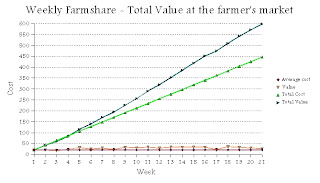

Here's a rundown of many weeks of vegetables since the little guy was born.
The weights and amounts of vegetables are real. The prices are largely based on interpolation between a few farmers' markets visits, a few good guesses on things I didn't run across at the market on the weeks I went, etc. We have managed to get (and either eat, or store) our vegetables each week, but I have not been religiously going to the farmers market somehow...
9/30 - week 16
1 bunch toscano kale - $2.50/bunch
bagged lettuce mix - $4/bag
1 bunch arugula - $2.50/bunch
3 lb 2 oz potatoes - $2/lb $6.25
1 bunch celery, 1lb 1oz - $2/bunch - $2
11oz broccoli - $3/lb - $2
3 lb 10 oz carnival squash - $1.80/lb - $6.50
2 leeks - $1/ea - $2
1 lb daikon - $1.50
1 lb tomato - $2.50
3hot peppers - $0.75
Total: $32.50
10/7 – week 17
bunch of kale - $2.50
bunch of baby bok choy - $1.50/ba
bagged lettuce - $4
2 lbs potatoes - $2/lb - $4
.25lb red onion - $1/lb - $0.25
.25lb garlic - $8/lb - $2
1.5lb carrots - $1/lb - $1.50
3lbs buttercup squash - $1.80/lb - $5.40
1lb eggplants - $1.50/lb - $1.50
total: $22.65
10/14 – week 18
1 bunch dino kale - $2.50
1 bag salad greens - $4
1 bag spinach $2.50
2 lb 1 oz delicata squash (3) - $1.80/lb - $3.70
1 lb 3 oz green peppers (6) - $3/lb - $3.56
3 lb 9 oz cauliflower - $2.50/lb - $8.90
12 oz broccoli - $3/lb - $2.25
1 lb turnip - $2/lb - $2
2 leeks - $1/ea - $2
1 lb 5 oz celery (1 bu) - $2
2 lb 5 oz carrots - $1/lb - $2.13
Total: $35.54
10/21 - Week 19
1 lb 5 oz cauiflower - $2.50/lb - $3.28
3 green peppers (1 lb) -$3
1 bunch kale - $2.50
1 head escarole - $2.50
15oz beets - $2/lb - $1.87
6 oz turnip - $2/lb - $0.75
4 lb 3 oz squash – Japanese pumpkin - $1.80/lb - $7.50
3lb cabbage - $1/lb - $3
5 oz garlic - $8/lb - $2.50
2 lb 13 oz potatoes - $2/lb - $5.60
Total: $32.50
10/28 – Week 20
14 oz broccoli - $3/lb - $2.62
2lb celery - $2/bu - $2
1 bunch arugula - $2.50
1 bunch collards - $2.50
2 leeks - $1/ea - $2
2lb 6oz sweet potato - $2.60/lb - $6.17
1 lb 12 oz rutabaga - $2/lb - 3.50
4 lb 6 oz pie pumpkin - $1.80/lb - $6.56
1 lb 10 oz carrots - $1/lb - $1.62
Total: $29.47
11/4 – Week 21
1 lb 14 oz giant brussel sprouts (more than 2 pint containers, but these were weird sized) - $3/pint - $6
1 lb 5 oz celeriac - $2/lb - $2.62
1 bunch red kale - $2.50
14 oz daikon radish - $2/lb - 1.75
10 oz beets - $2/lb - $1.25
2 lb delicata squash - $1.80/lb - $3.60
7 oz red onion - $1/lb - $0.50
10 oz garlic - $8/lb - $5
3 lb 4 oz potatoes $3.25
Total: $26.47
The resulting savings has just crossed the $150 mark this week!
And the resulting plots -


Sunday, October 17, 2010
a short hiatus
In addition to all those vegetables, this growing season also brought us a baby.

He's almost 2 weeks old now, and eventually I'll get some posts up about the farmshare again. I am still keeping track of the data on what's been in our farmshare box and what it cost at the farmer's market. The week he came home, our box didn't even come to our house - a friend with the same share weighed everything in the box for me, delivered us the root vegetables, and brought us many of the items cooked or otherwise ready-to-eat, giving us time to catch up and feel ready for the following week's box to hit our fridge.

He's almost 2 weeks old now, and eventually I'll get some posts up about the farmshare again. I am still keeping track of the data on what's been in our farmshare box and what it cost at the farmer's market. The week he came home, our box didn't even come to our house - a friend with the same share weighed everything in the box for me, delivered us the root vegetables, and brought us many of the items cooked or otherwise ready-to-eat, giving us time to catch up and feel ready for the following week's box to hit our fridge.
Tuesday, September 28, 2010
Market Analysis : Week 15
Week 15, September 23
Still more cooking and storing than blogging. But no throwing away of things that have gone bad, so these savings are real, at least, assuming I'd be buying this much food at the farmers' market, not letting my inner cheapskate talk me into buying some cheaper, less local option at the grocery store in-season, and so on.
While I've been fairly busy and tired for elaborate food projects (or for posting and photographing things for that matter), simple things are still a fine way to eat farmshare food. We steam many of the greens that arrive in the box and save them for later, when we'll be missing the freshest food in the winter. Last night we ate dinner consisting of leftovers plus freshly steamed broccoli. The most complicated leftover was a bread salad in which many farmshare vegetables, particularly tomatoes, were chopped up and tossed in a dressing of vinegar, olive oil, and tomato juice. I suppose the beet tzatziki (shredded boiled beets, yogurt, garlic, lemon juice, and dill) was about as complicated, but I've made it so many times that it doesn't feel that way. We also ate boiled farm potatoes that were cooked a few days ago.
1 bunch kale: $2.50
1 bunch parsley: $2
2 lb 13 oz tomatoes: $7
10 oz broccoli : $1.87
1 bunch bok choi (a variety with darker leaves): $3.50
14 oz fall turnip : $1.75
1.25 lb acorn squash: $1.25
1/2lb bell pepper : $1.50
2 hot peppers: $0.50
3.25lb potatoes : $9.75
1 lb red onion: $2
Total: $33.62


Still more cooking and storing than blogging. But no throwing away of things that have gone bad, so these savings are real, at least, assuming I'd be buying this much food at the farmers' market, not letting my inner cheapskate talk me into buying some cheaper, less local option at the grocery store in-season, and so on.
While I've been fairly busy and tired for elaborate food projects (or for posting and photographing things for that matter), simple things are still a fine way to eat farmshare food. We steam many of the greens that arrive in the box and save them for later, when we'll be missing the freshest food in the winter. Last night we ate dinner consisting of leftovers plus freshly steamed broccoli. The most complicated leftover was a bread salad in which many farmshare vegetables, particularly tomatoes, were chopped up and tossed in a dressing of vinegar, olive oil, and tomato juice. I suppose the beet tzatziki (shredded boiled beets, yogurt, garlic, lemon juice, and dill) was about as complicated, but I've made it so many times that it doesn't feel that way. We also ate boiled farm potatoes that were cooked a few days ago.
1 bunch kale: $2.50
1 bunch parsley: $2
2 lb 13 oz tomatoes: $7
10 oz broccoli : $1.87
1 bunch bok choi (a variety with darker leaves): $3.50
14 oz fall turnip : $1.75
1.25 lb acorn squash: $1.25
1/2lb bell pepper : $1.50
2 hot peppers: $0.50
3.25lb potatoes : $9.75
1 lb red onion: $2
Total: $33.62


Monday, September 20, 2010
Market Analysis: Week 14
Week 14, September 16
4 lb Acorn Squash (2 squashes): $1/lb, $4
4 lb Tomatoes (about a dozen tomatoes, orange and red): $2.5/lb, $10
Hot Peppers: 4 hot peppers, 25c ea, $1
1.5lb Peppers (1 orange, 2 red, 1 green): $3/lb, $4.50
3 Leeks: $3
1 Head lettuce: $2.50
1 bunch chard : $2.50
1 bunch Hon Tsai Tai: (an Asian green with edible stems and flowers): $3
Dill: $2 / bunch
Total: $32.50


4 lb Acorn Squash (2 squashes): $1/lb, $4
4 lb Tomatoes (about a dozen tomatoes, orange and red): $2.5/lb, $10
Hot Peppers: 4 hot peppers, 25c ea, $1
1.5lb Peppers (1 orange, 2 red, 1 green): $3/lb, $4.50
3 Leeks: $3
1 Head lettuce: $2.50
1 bunch chard : $2.50
1 bunch Hon Tsai Tai: (an Asian green with edible stems and flowers): $3
Dill: $2 / bunch
Total: $32.50


Saturday, September 4, 2010
Market Analysis : Week 12 & 13
My farmshare ate my blogging the past few weeks - but I'm still here, cooking my way through the late summer bounty and then some. (Why no, it's not almost fall, and it wasn't 55F this morning, and I'm not in denial.) So we'll catch up on 2 weeks at once.
Week 12's share, September 1:
Sweet Corn: 6 ears plus bonus baby corn again. 50c/ear - $3
2.5 lbs Spaghetti Squash: $2.50
1 lb Carrots: $2
1 lb 9 oz Cucumbers: $3
Red Peppers: 50c
2 Leeks: $2
1 Kohlrabi: 50c
2lb 10oz Tomatoes: $6.50
2 Jalapeno Peppers: 25c ea, $0.50
1 head of red "Magenta" lettuce: $2.50
1 large bunch Bok Choy: $2.50
1 bunch Cilantro: $2
1 bunch Dill: $2
Total: $29.50
Week 13's share, September 9:
4 lbs 6 oz tomatoes : $11
2 Jalapeno peppers : 25c ea, $0.50
1 head of lettuce: $2.50
1 bunch basil: $2
1 lb 11oz cucumbers: $3.37
3 bell peppers (14 oz): $2.60
4 red onions (10 oz): $1.25
2 lb 4 oz potatoes: $6.75
6 ears corn: $3
Total: $32.97
Savings at the end of this week is up past $75!


In addition to all this (forgetting I'd probably get *plenty* of corn and tomatoes in the regular share) I ordered extra tomatoes at $1.50 a lb and corn at $3/a dozen and basil at $3/a lb. I made sauce with the tomatoes (and plenty of the ones from the share), pesto with the basil, and froze the corn - half as frozen cooked kernels and half in a creamy corn soup. It's all finally in the freezer, and I've still got roasted jalapenos to cook with the rest of the tomatoes into some salsa to freeze.
Week 12's share, September 1:
Sweet Corn: 6 ears plus bonus baby corn again. 50c/ear - $3
2.5 lbs Spaghetti Squash: $2.50
1 lb Carrots: $2
1 lb 9 oz Cucumbers: $3
Red Peppers: 50c
2 Leeks: $2
1 Kohlrabi: 50c
2lb 10oz Tomatoes: $6.50
2 Jalapeno Peppers: 25c ea, $0.50
1 head of red "Magenta" lettuce: $2.50
1 large bunch Bok Choy: $2.50
1 bunch Cilantro: $2
1 bunch Dill: $2
Total: $29.50
Week 13's share, September 9:
4 lbs 6 oz tomatoes : $11
2 Jalapeno peppers : 25c ea, $0.50
1 head of lettuce: $2.50
1 bunch basil: $2
1 lb 11oz cucumbers: $3.37
3 bell peppers (14 oz): $2.60
4 red onions (10 oz): $1.25
2 lb 4 oz potatoes: $6.75
6 ears corn: $3
Total: $32.97
Savings at the end of this week is up past $75!


In addition to all this (forgetting I'd probably get *plenty* of corn and tomatoes in the regular share) I ordered extra tomatoes at $1.50 a lb and corn at $3/a dozen and basil at $3/a lb. I made sauce with the tomatoes (and plenty of the ones from the share), pesto with the basil, and froze the corn - half as frozen cooked kernels and half in a creamy corn soup. It's all finally in the freezer, and I've still got roasted jalapenos to cook with the rest of the tomatoes into some salsa to freeze.
Monday, August 30, 2010
Would you like a salad with that?
Yesterday I steamed my arugula, since a 2nd bunch had arrived in the farmshare before we finished the first. I'm not sure what I'll do with it, but now it won't wilt and spoil before I get there. I'm thinking pureed into some kind of chilled soup, maybe with potato and a little fruit for sweetness.
That still left a rather full salad drawer. But today was my annual day of forgetting to wear sunblock while spending several hours in midday sun. It was probably even in the bag we brought to the pool, but somehow that didn't help my sun exposure much. So by dinner time I had that slightly sleepy feeling I get from sun exposure, and I did not require any convincing at all when the youngest family member voted for pizza.
But those greens in the drawer! Could I neglect them for yet another day? While waiting for the pizza I got a plentiful bunch of greens into the salad spinner and placed them in two of our bowl-shaped plates, chopped up a small orange tomato into half-wedges and sprinkled them on top of each plate, and sliced one of the plentiful cucumbers onto the salad plates as well. Last came slices of goat cheese from the farmers' market, and some vinaigrette dressing with basil. (Picky eater's version: some lettuce and some cucumber slices, undressed.) The salad, in a dinner-sized plate, wasn't really a side, but the meal felt more substantial accompanied by some pizza.
So remember to ask yourself, even if it's takeout - would you like a salad with that?
That still left a rather full salad drawer. But today was my annual day of forgetting to wear sunblock while spending several hours in midday sun. It was probably even in the bag we brought to the pool, but somehow that didn't help my sun exposure much. So by dinner time I had that slightly sleepy feeling I get from sun exposure, and I did not require any convincing at all when the youngest family member voted for pizza.
But those greens in the drawer! Could I neglect them for yet another day? While waiting for the pizza I got a plentiful bunch of greens into the salad spinner and placed them in two of our bowl-shaped plates, chopped up a small orange tomato into half-wedges and sprinkled them on top of each plate, and sliced one of the plentiful cucumbers onto the salad plates as well. Last came slices of goat cheese from the farmers' market, and some vinaigrette dressing with basil. (Picky eater's version: some lettuce and some cucumber slices, undressed.) The salad, in a dinner-sized plate, wasn't really a side, but the meal felt more substantial accompanied by some pizza.
So remember to ask yourself, even if it's takeout - would you like a salad with that?
Saturday, August 28, 2010
What's in a box of peaches?
I was worried that I had bitten off more than I could chew this year, with a giant box of peach seconds from Nicewicz Farm, found at the Arlington Center farmer's market.
Last year, when I bought the same delicious giant box of peach seconds, they were mostly "split pits" that tasted great, but if you didn't stay on top of them would rot very fast from the inside out - one morning they'd look fine, that afternoon only half could be saved. Which was fine when one had a bunch of free time coming up - as opposed to planning to disappear for a weekend of camping.
You may recall that the first thing I did with the peaches (aside from just devouring a few, of course) was a lovely peach upside down cake. I also shared about 5 lbs with a friend who couldn't get to the market as fast as me.
And then, the day before the camping trip, I frantically decided I'd better at least do some canning. So another portion of the peaches got peeled, sliced, then put into a very light sugar syrup and dropped into pint jars, then processed in boiling water and stuck in the pantry. I've never done this before and hope I like the results come winter - for now, I'll just be eating the fresh ones for a few more weeks!

The morning of the camping trip, I cut up a quart container's worth of peaches that looked most likely to spoil soon - I think I'm getting better at recognizing split pits. Then they went into the cooler we planned to bring on the trip. Another dozen or so went into a container, whole, to keep an eye on, eat whole, or perhaps even grill. The sliced peaches became a peach cobbler, cooked over a charcoal grill at the campsite in a cast iron dutch oven. The whole ones landed in our breakfast oatmeal, as well as in the bellies of a number of little girls. We managed to bring a few home, even - and successfully returned home to find that the remaining peaches in the bottom of the box were still fine as well. It turns out that this year's batch was not so many split pits, and more peaches with little blemishes on the skin or bruises acquired during picking, so far fewer of them were little ticking time-bombs.
So next up: peach cardamom jam, with a bit of grated ginger, an equal amount of sugar by weight to the fruit, and a generous amount of cardamom, freshly crushed from the pods. I used about 3.5 lbs of peaches, after chopping and peeling. Even the ginger was local - harvested last year by Old Friends Farm and saved in my freezer. I haven't had a problem with stone fruit jams without pectin, and I do use plenty of sugar, and in cool weather I don't even get impatient letting it cook long enough to set.

That left a few more peaches for eating, and just enough to try making some delicious-sounding spiced peach muffins - a huge muffin recipe from King Arthur Flour, with tons of flour, that supposedly freezes well. And a great snack for when friends were coming over for the afternoon - they could finish baking and be ready just in time for afternoon snack. Well, a fine theory, except that I seem to have invented a strange batch of sugar-free muffins, after being sure to hit the supermarket to replenish our brown sugar and everything. The doorbell rang as I'd just put in all the dry ingredients *but* the sugar, and somehow when I got back into the kitchen I was convinced I'd already added all the dry ingredients. For completely sugar free muffins, they were pretty tasty with all the peachy sweetness - but next time, I'll be a little more careful!
This entry is part of a blogathon in support of Mass Farmers Markets. If you appreciate the markets that help make such fabulous local produce available to us every week during the growing season, please consider donating what you can. The blogathon has been organized by Tinky of In Our Grandmother's Kitchens.

Last year, when I bought the same delicious giant box of peach seconds, they were mostly "split pits" that tasted great, but if you didn't stay on top of them would rot very fast from the inside out - one morning they'd look fine, that afternoon only half could be saved. Which was fine when one had a bunch of free time coming up - as opposed to planning to disappear for a weekend of camping.
You may recall that the first thing I did with the peaches (aside from just devouring a few, of course) was a lovely peach upside down cake. I also shared about 5 lbs with a friend who couldn't get to the market as fast as me.
And then, the day before the camping trip, I frantically decided I'd better at least do some canning. So another portion of the peaches got peeled, sliced, then put into a very light sugar syrup and dropped into pint jars, then processed in boiling water and stuck in the pantry. I've never done this before and hope I like the results come winter - for now, I'll just be eating the fresh ones for a few more weeks!

The morning of the camping trip, I cut up a quart container's worth of peaches that looked most likely to spoil soon - I think I'm getting better at recognizing split pits. Then they went into the cooler we planned to bring on the trip. Another dozen or so went into a container, whole, to keep an eye on, eat whole, or perhaps even grill. The sliced peaches became a peach cobbler, cooked over a charcoal grill at the campsite in a cast iron dutch oven. The whole ones landed in our breakfast oatmeal, as well as in the bellies of a number of little girls. We managed to bring a few home, even - and successfully returned home to find that the remaining peaches in the bottom of the box were still fine as well. It turns out that this year's batch was not so many split pits, and more peaches with little blemishes on the skin or bruises acquired during picking, so far fewer of them were little ticking time-bombs.
So next up: peach cardamom jam, with a bit of grated ginger, an equal amount of sugar by weight to the fruit, and a generous amount of cardamom, freshly crushed from the pods. I used about 3.5 lbs of peaches, after chopping and peeling. Even the ginger was local - harvested last year by Old Friends Farm and saved in my freezer. I haven't had a problem with stone fruit jams without pectin, and I do use plenty of sugar, and in cool weather I don't even get impatient letting it cook long enough to set.

That left a few more peaches for eating, and just enough to try making some delicious-sounding spiced peach muffins - a huge muffin recipe from King Arthur Flour, with tons of flour, that supposedly freezes well. And a great snack for when friends were coming over for the afternoon - they could finish baking and be ready just in time for afternoon snack. Well, a fine theory, except that I seem to have invented a strange batch of sugar-free muffins, after being sure to hit the supermarket to replenish our brown sugar and everything. The doorbell rang as I'd just put in all the dry ingredients *but* the sugar, and somehow when I got back into the kitchen I was convinced I'd already added all the dry ingredients. For completely sugar free muffins, they were pretty tasty with all the peachy sweetness - but next time, I'll be a little more careful!
This entry is part of a blogathon in support of Mass Farmers Markets. If you appreciate the markets that help make such fabulous local produce available to us every week during the growing season, please consider donating what you can. The blogathon has been organized by Tinky of In Our Grandmother's Kitchens.
Market Analysis: week 11
Today's farmshare came in a large box and was good and heavy. Here's a picture of the haul:

And the rundown of the contents and the farmer's market prices:
Sweet Corn: 6 ears, $3
Yellow-flesh Watermelon: 8 lbs? more? Call it $6.
Carrots: 14 oz : $1
Cucumbers: 3lbs 1 oz $4.50
Yellow Squash: 1 lb, $2
Onions: 1 medium onion, 0.50c
Tomatoes: mix of heirloom and regular, 1 lb 10oz : $4.87
red "Magenta" lettuce : 1 head, $2.50
arugula : 1 bunch, $2.50
Red Kale: 1 bunch, $2.50
Basil: 1 bunch, $2
Cilantro: 1 bunch, $2
Total: $33.37

And the savings vs buying this stuff individually at the farmer's market:

Not included on the list, several of our ears of corn had a fun bonus this week. (No, I don't meant the corn worms.) They'd grown with an extra "twin" ear of corn attached, which separated from the ear before peeling and was much tinier - and as I suspected, basically the same thing the baby corn you get in your takeout stirfied noodles. It would be quite a pain to harvest enough for an actual stirfry, but we cooked 3 in a bit of boiling water and then snacked on them.

And the rundown of the contents and the farmer's market prices:
Sweet Corn: 6 ears, $3
Yellow-flesh Watermelon: 8 lbs? more? Call it $6.
Carrots: 14 oz : $1
Cucumbers: 3lbs 1 oz $4.50
Yellow Squash: 1 lb, $2
Onions: 1 medium onion, 0.50c
Tomatoes: mix of heirloom and regular, 1 lb 10oz : $4.87
red "Magenta" lettuce : 1 head, $2.50
arugula : 1 bunch, $2.50
Red Kale: 1 bunch, $2.50
Basil: 1 bunch, $2
Cilantro: 1 bunch, $2
Total: $33.37

And the savings vs buying this stuff individually at the farmer's market:

Not included on the list, several of our ears of corn had a fun bonus this week. (No, I don't meant the corn worms.) They'd grown with an extra "twin" ear of corn attached, which separated from the ear before peeling and was much tinier - and as I suspected, basically the same thing the baby corn you get in your takeout stirfied noodles. It would be quite a pain to harvest enough for an actual stirfry, but we cooked 3 in a bit of boiling water and then snacked on them.
Thursday, August 19, 2010
Market Analysis: Week 10

This week's box (I know, it all looks like lettuce and chard, but there's actually plenty of other stuff in there...)
Sweet Corn: 7 ears, 50c/ear : $3.50
Canteloupe : 4 lb, 12 oz : $3.80
Carrots: 10oz, $1
Cucumbers: 1 lb, 15 oz : $3.87
Yellow Squash: 1 lb, 6 oz : $2
"Ailsa Craig" Onions (sweet): 2 tiny onions: $1
Tomatoes: 2 lb, $6
"Concept" Lettuce: 1 head, $2.50
Arugula: 1 bunch, $2.50
Swiss Chard: 1 bunch, $2.50
Basil: 1 bunch, $2
total: $30.67
Pretty graphs:
 alt=""id="BLOGGER_PHOTO_ID_5507318568551090450" />
Subscribe to:
Posts (Atom)